English to German
Live Translation
for Churches
Serve your German-speaking congregation in real time — no app download, no hardware, under 1.5 seconds of latency.
- English
- Turkish
- Hindi
- Korean
- French
- Polish
- + More…
German at a Glance
- Native Speakers
- 100M+
- Countries (official)
- 5
- Script
- Latin
- Tradition
- Lutheran & Reformed
- Translation Latency
- <1.5s
German Translation Accuracy
LiveSunday is engineered for the unique demands of live worship — theological precision, real-world audio conditions, and the languages your congregation speaks at home.
- Reformation-rooted theological vocabularyLuther's translation shaped German biblical vocabulary for five centuries. Common terms like Gnade (grace), Erlösung (redemption), Heiliger Geist (Holy Spirit), and Sünde (sin) are everyday German to the speech model. Add the rarer names and terms your church uses as keywords.
- Austrian and Swiss German accents supportedWhether your speaker has a Hochdeutsch, Austrian, or Swiss German accent, the transcription handles phonetic variation without losing accuracy or introducing misheard words.
- Complex compound words handledGerman's compound noun structure (e.g. Nächstenliebe, Glaubensbekenntnis) is handled correctly in both transcription and translation without splitting words at incorrect boundaries.
- Formal theological register maintainedGerman Christian worship uses a distinctly formal register. The system distinguishes colloquial German from the elevated language common in Reformed, Lutheran, and Catholic liturgy.
About the German Language
- Speakers
- Over 100 million native speakers primarily in Germany (83M), Austria (9M), Switzerland (5M), and Luxembourg. Also spoken in South Tyrol (Italy), East Belgium, and significant diaspora communities globally.
- Dialects
- Standard German (Hochdeutsch) is the written and formal spoken norm. Major dialect groups include Bavarian, Alemannic (Swiss German, Swabian), Low German (Niederdeutsch), and Ripuarian (Cologne). Church services typically use standard Hochdeutsch.
- Geographic Reach
- Official language of Germany, Austria, Switzerland (one of four), Luxembourg, and Liechtenstein. One of the 24 official languages of the European Union. German diaspora communities are significant in Brazil, the United States, Canada, and Russia.
- Linguistic Notes
- West Germanic language using the Latin alphabet with three umlauts (ä, ö, ü) and the ligature ß.
- Highly inflected — four grammatical cases (nominative, accusative, dative, genitive) and three genders (masculine, feminine, neuter).
- Compound word formation allows words of great length; context is critical for correct interpretation by AI models.
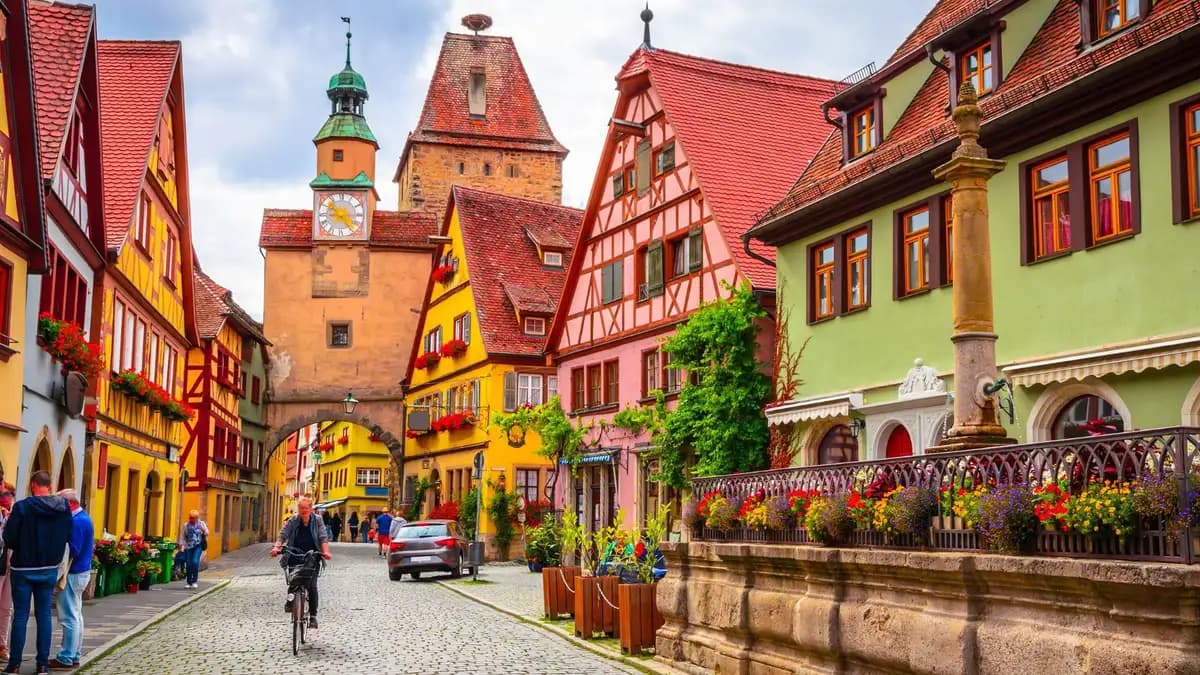
Running German live translation in practice
German has a few traits that change how live captions read and how you should set up a service. These notes come from how the language works, so they apply whether you translate into German or from it.
The verb often comes last
In German subordinate clauses the main verb sits at the end: "...weil Gott uns liebt" puts "liebt" last. When a German speaker is translated into English, the translation can only commit to the meaning once the verb arrives, so captions sometimes trail by a clause during long sentences. Speakers who use shorter sentences get noticeably smoother captions.
Sie or du
German marks formality in every sentence. Traditional Lutheran and Catholic services usually address the congregation formally, while many free churches and youth services use du and ihr. Translated captions follow the tone of the English source, so a casual English sermon reads as casual German.
Bible names follow the Luther tradition
German Bibles use their own forms of names: Mose for Moses, Elia for Elijah, Johannes for John, Jakobus for James. Add any your church uses often, plus local place and team names, as German keywords so the transcription spells them the way your congregation expects.
Hochdeutsch in the pulpit, dialect in the room
Most sermons in Germany, Austria and Switzerland are preached in standard German, which transcribes best. Swiss German dialect is a different matter: it has no standard spelling, and a speaker who switches fully into Schwiizerdütsch will see more errors than one who keeps to Swiss Standard German.
Conferences and events in the DACH region
German is a common working language at events in Germany, Austria and Switzerland, often alongside English. Listeners scan a QR code and pick German or English on their own phone, so you don't need interpreter booths or headsets for a bilingual audience. On the Advanced plan, listeners can also hear spoken German translation.
Everything you need for live events
Transcript
Sun, Nov 1, 2026
Welcome, everyone, to this morning's gathering. It's good to see so many familiar faces, and a few new ones too.
Before we begin, let's take a moment to quiet our hearts. Today we're opening the book of Hebrews, chapter seven.
This Melchizedek was king of Salem and priest of God Most High. He met Abraham returning from the battle and blessed him.
Full Transcript History & Analytics
Review complete transcripts and usage insights after every session.
Fine-tuned Models with Custom Keywords
Add custom vocabulary for names, places, and domain-specific terms.
Integrate with Your Display Apps
Connect with OBS, ProPresenter, vMix, EasyWorship, and more. See the integration guides.
Control Remotely via API
Start streams, toggle captions, and drive LiveSunday from ProPresenter, Companion, or any HTTP client.
Organization
Shown to your listeners
Name
Logo
Powered by LiveSunday
Captions appear here as soon as you go live.
Add your own branding
Add your organization's name and logo, and listeners see your brand when they join.
Invitations
Invite operators to run your streams
Invite Your Team
Send an email invite and volunteers can run the console. Only the owner handles billing.
Common questions about German translation
Explore other languages
LiveSunday supports 100+ languages. Explore dedicated guides for the most commonly requested church translation languages.